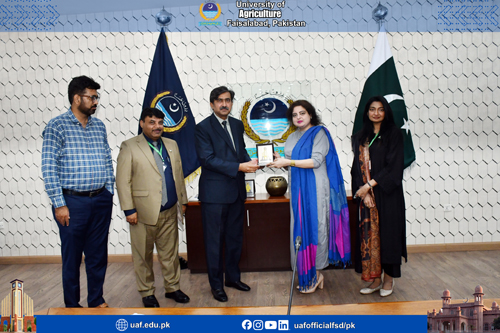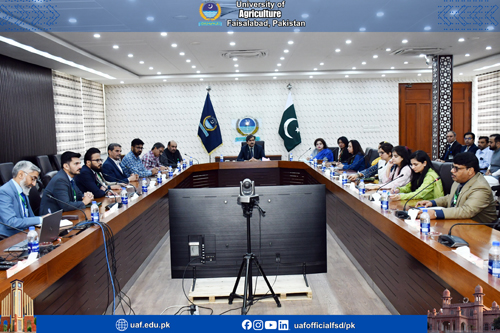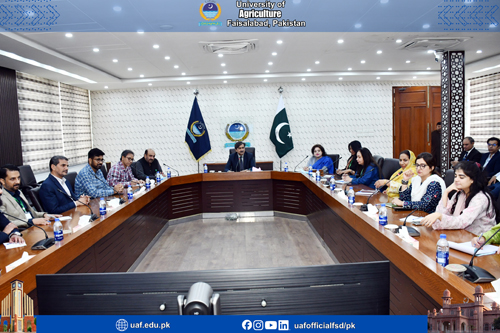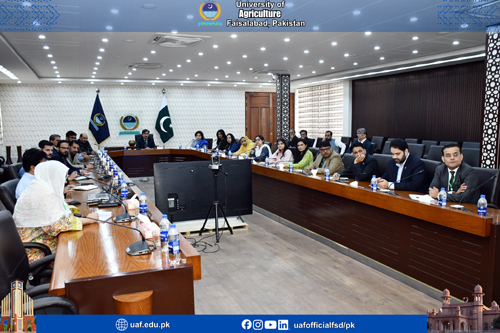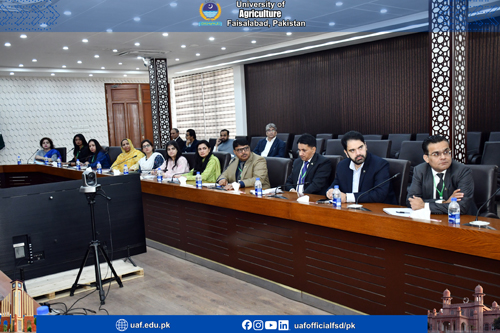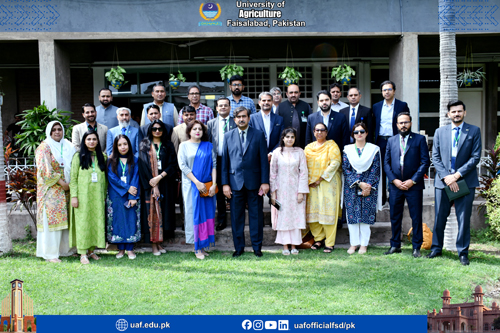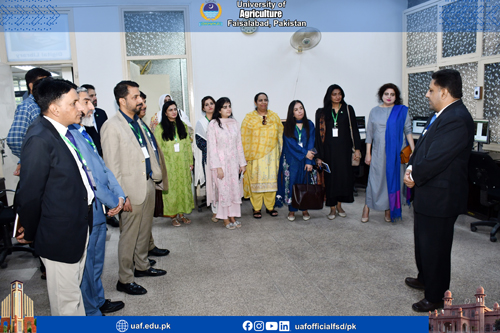

A delegation of the Senior Management Course of the National Institute of Public Administration (NIPA) visted UAF.
FAISALABAD, September 17: The deteriorating economic condition of the farming community, declining farm profitability and shrinking soil health are posing serious challenges to the agriculture sector, requiring tangible measures to make farming a profitable and sustainable profession, said University of Agriculture Faisalabad (UAF) Vice Chancellor Prof Dr Zulfiqar Ali. He was speaking to a delegation of the Senior Management Course of the National Institute of Public Administration (NIPA), led by Directing Staff Onsia Zafar, which visited the University of Agriculture Faisalabad. Prof Zulfiqar Ali warned that Pakistan could face a wheat crisis within the next decade, similar to the crisis currently confronting the cotton sector, if timely and practical measures were not taken to address structural problems in agriculture and address farmers profitably issue. The Vice Chancellor said that technologies capable of improving agricultural productivity were available, but farmers were unable to adopt them because of affordability constraints, limited access to markets and inadequate mechanisms for technology transfer. He said soil organic matter in Pakistan was very low, adversely affecting soil fertility, nutrient-use efficiency, water retention and long-term productivity. Improving soil health, he added, should therefore be made one of central component of agricultural initiatives . “Unless farming becomes economically viable, the younger generation will continue to move away from agriculture,” Prof Zulfiqar Ali said, pointing out that many farmers’ sons were reluctant to enter farming because of low and uncertain profitability. He said farmers were also being exploited by intermediaries because of weak market linkages. Discussing oilseed production, Prof Zulfiqar Ali said weeds were among the major constraints affecting soybean production and biotechnology could potentially provide tools to address such challenges. He stressed the need for strengthening agricultural research, agricultural extension and technology transfer. He said that UAF was taking steps to produce and promote quality seed and propagate it with the help of industry. The Vice Chancellor said universities could play a greater role in addressing farmers’ problems by strengthening research-industry linkages and ensuring that innovations developed in laboratories reached fields. He called for stronger academia-industry partnerships to develop affordable technologies, improve seed quality, strengthen value chains, promote value addition and create market opportunities for farmers. He said that Lyallpur model under which agriculture extension, agriculture research and academia are working under roof is in place in Indian Punjab and making the marvelous results. That model may be revamped in Pakistan. He said the way forward required a shift from short-term interventions to a comprehensive strategy focused on profitable farming, soil restoration, quality seed, efficient water use, affordable mechanisation, modern technology, better markets and stronger farmer-industry linkages. The delegation discussed various aspects of agricultural education, research, innovation and the role of universities in addressing emerging challenges facing Pakistan’s agriculture sector.