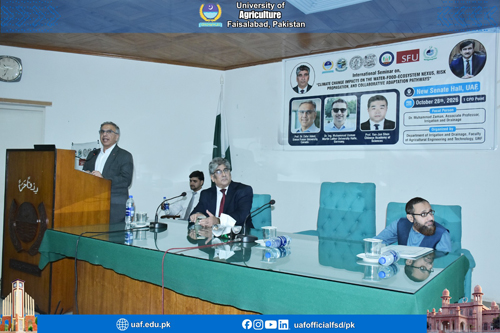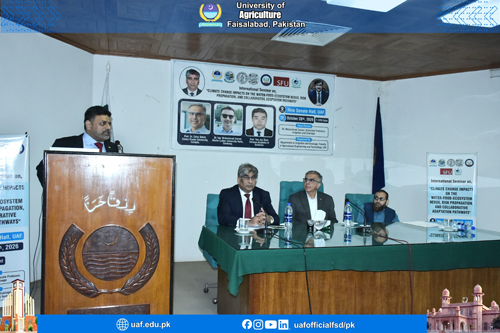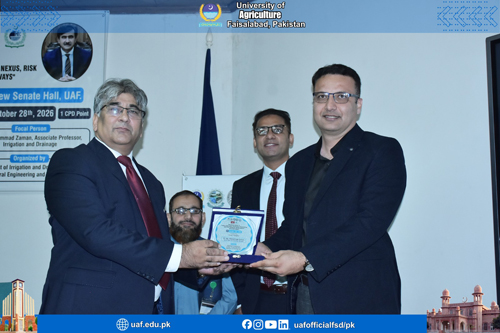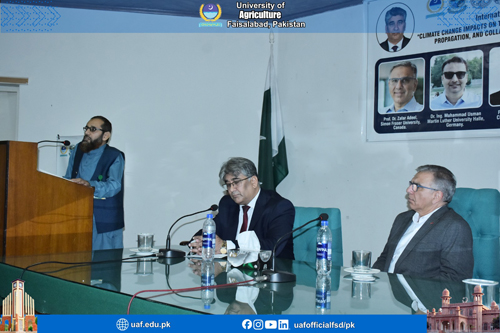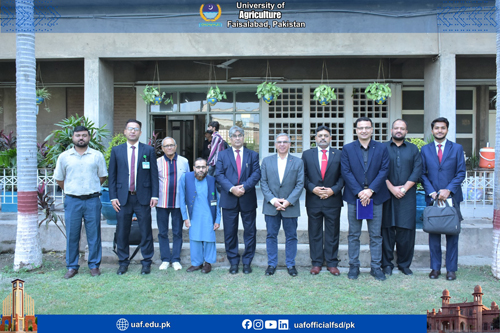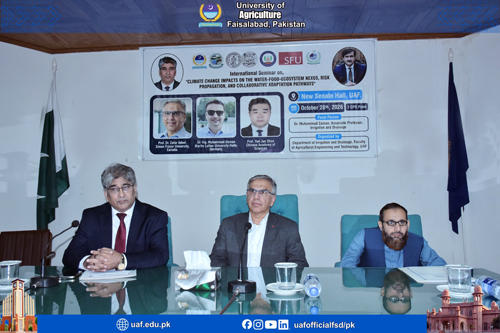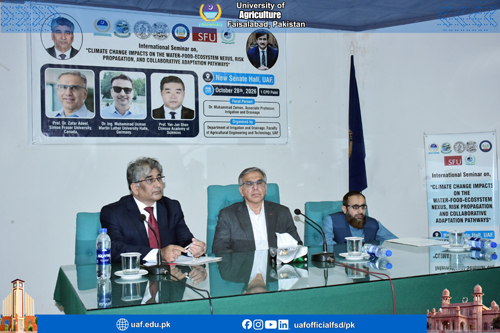

The seminar, titled “Climate Change Impacts on the Water-Food-Ecosystem Nexus, Risk Propagation, and Collaborative Adaptation Pathways”, was organised by the Department of Irrigation and Drainage, Faculty of Agricultural Engineering and Technology.
FAISALABAD Oct 28: Climate change is threatening water and food security, agricultural productivity and ecological sustainability, underscoring the need for integrated research, efficient water management and modern technologies to strengthen Pakistan’s resilience, experts said at an international seminar at the University of Agriculture Faisalabad (UAF). The seminar, titled “Climate Change Impacts on the Water-Food-Ecosystem Nexus, Risk Propagation, and Collaborative Adaptation Pathways”, was organised by the Department of Irrigation and Drainage, Faculty of Agricultural Engineering and Technology, to explore climate-related risks and collaborative adaptation strategies. Dean Faculty of Agricultural Engineering and Technology Dr Anjum Munir called for sustainable measures to curb environmental pollution and carbon emissions, stressing the need to promote solar energy and cleaner transportation to address climate challenges and growing energy demands. Prof Dr Zafar Adeel emphasised an integrated approach to water management, food security and ecosystem protection, urging universities and research institutions to strengthen interdisciplinary research and international cooperation to support evidence-based policymaking. Dr Muhammad Usman of Martin Luther University Halle-Wittenberg, Germany, warned that water scarcity, erratic rainfall and environmental degradation could undermine agricultural productivity and food security. He stressed the importance of identifying climate risks early and developing effective mitigation and adaptation strategies. Dr Adnana Shahid called for stronger international academic collaboration and knowledge-sharing to translate scientific research into practical solutions for climate resilience and long-term sustainability. Prof Dr Muhammad Zaman highlighted the need to invest in clean energy, environmentally friendly transport and sustainable development to reduce carbon emissions and protect natural resources. Lt Col (R) Ghazanfar Raza of Margalla Green Division stressed self-reliance in agricultural mechanisation, calling for investment in local expertise, technical training and indigenous engineering solutions to reduce dependence on imported technologies and strengthen national food security. Prof Yan-Jun Shen of the Chinese Academy of Sciences emphasised scientific innovation, efficient water use and sustainable irrigation practices to maintain agricultural productivity under changing climatic conditions.